The name Isla has a gentle sound and a beautiful connection to nature. It is now widely used as a feminine given name, especially in English-speaking countries. Many parents search for the Isla name meaning because they want a name that feels peaceful, elegant, and meaningful. Its history has connections with Scotland, while the Spanish word isla means “island.”
But what about the biblical side of the name? Isla meaning in the Bible needs a little explanation because Isla is not traditionally listed as a personal name in the Bible. Still, its associations with islands, water, peace, refuge, and being set apart can be explored through biblical themes. Understanding the difference between the name’s actual history and later spiritual interpretation gives a clearer picture of its meaning.
What Does the Name Isla Mean? (Definition & Etymology)
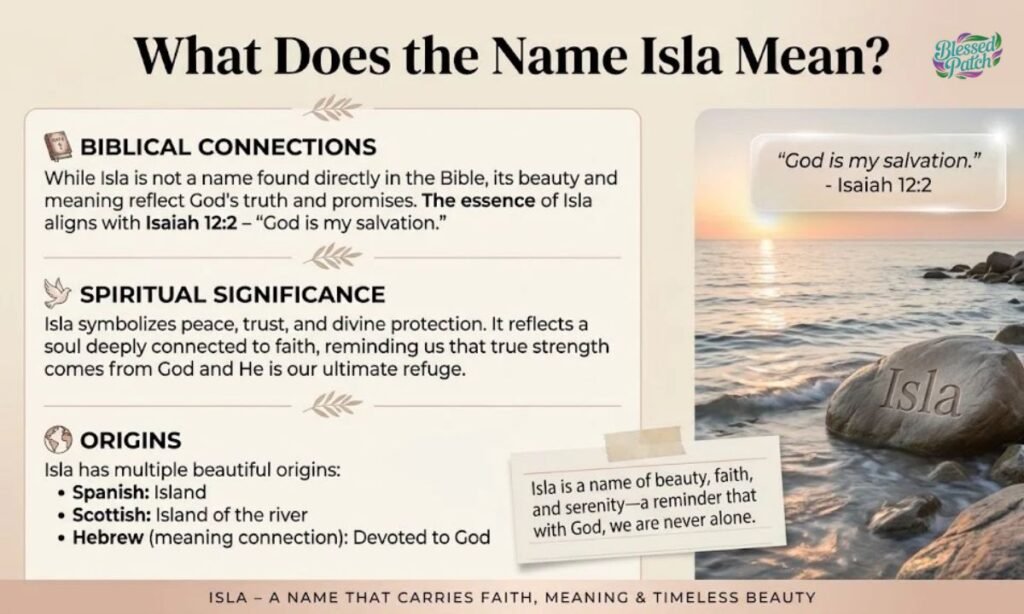
Isla is generally used as a feminine given name. It has more than one linguistic association, which is one reason its meaning can vary depending on the source.
In Scottish naming history, Isla is connected with Islay, the name of an island in Scotland’s Inner Hebrides. Islay has also been associated with Scottish rivers called Isla. The exact original meaning of the Scottish place-name is not certain.
There is also a direct Spanish connection. In Spanish, isla means “island.” This gives the name a simple nature-based meaning when it is understood through Spanish vocabulary.
Because of these different associations, Isla can be connected with ideas such as an island, nature, water, and a peaceful place surrounded by the sea. However, it is important not to claim that every one of these meanings comes from the same linguistic root.
In modern naming, Isla is usually understood as a graceful feminine name rather than as a word with one universally agreed ancient definition.
Origin of the Isla Name
The history of Isla is interesting because two major associations are often discussed: the Scottish place-name connection and the Spanish word isla.
Scottish Origin: Islay and the River Isla
The Scottish connection is usually traced to Islay, an island in the Inner Hebrides. Isla is also the name of Scottish rivers. The modern given name Isla developed as a feminine name associated with these Scottish place-names.
The exact etymology of Islay itself is uncertain. Therefore, it is better to describe Isla as a name connected with Scottish geography rather than assign it a definite ancient meaning that cannot be firmly established.
This Scottish background gives Isla a strong connection with landscapes, islands, rivers, and natural beauty. It also explains why the name is often included among Scottish-inspired baby names.
Spanish Origin: Isla Meaning “Island”
In Spanish, isla directly means “island.” This is a clear vocabulary meaning rather than a disputed etymology.
An island can naturally bring to mind water, calm surroundings, distance from noise, and a distinct place of its own. These ideas have helped give Isla a peaceful and poetic feel in modern baby-name discussions.
Still, the Spanish word meaning and the Scottish given-name history should be treated as separate linguistic connections. They both help explain why people associate Isla with islands, but they do not necessarily prove that the modern name has one single origin.
How Do You Pronounce Isla?
Isla is commonly pronounced with two syllables.
The pronunciation used in English is generally “EYE-lah.”
The spelling can look confusing at first because the letter s is silent in the common English pronunciation. This makes Isla different from names where every written letter is pronounced.
For parents choosing the name, its pronunciation is worth considering because people who have never seen it before may initially pronounce it incorrectly. Once learned, however, the pronunciation is short and easy to remember.
Is the Name Isla Mentioned in the Bible?
No. Isla is not traditionally recorded as a personal name in the Bible.
This distinction is important when researching the Isla meaning in the Bible. The name should not be presented as though it were the name of a biblical woman, prophet, place, or other person mentioned in Scripture.
The Bible does, however, mention islands and uses islands and coastlands in several contexts. Biblical references to islands can describe distant lands and nations. Isaiah, for example, uses language about islands and coastlands when speaking about peoples who are called to hear or respond to God.
Therefore, Isla has a biblical thematic connection, rather than a direct biblical-name connection.
That difference makes the topic more accurate. The name itself is not a biblical name, but some of the images associated with it can be compared with themes found in Scripture.
Isla Meaning in the Bible: Spiritual Symbolism and Themes
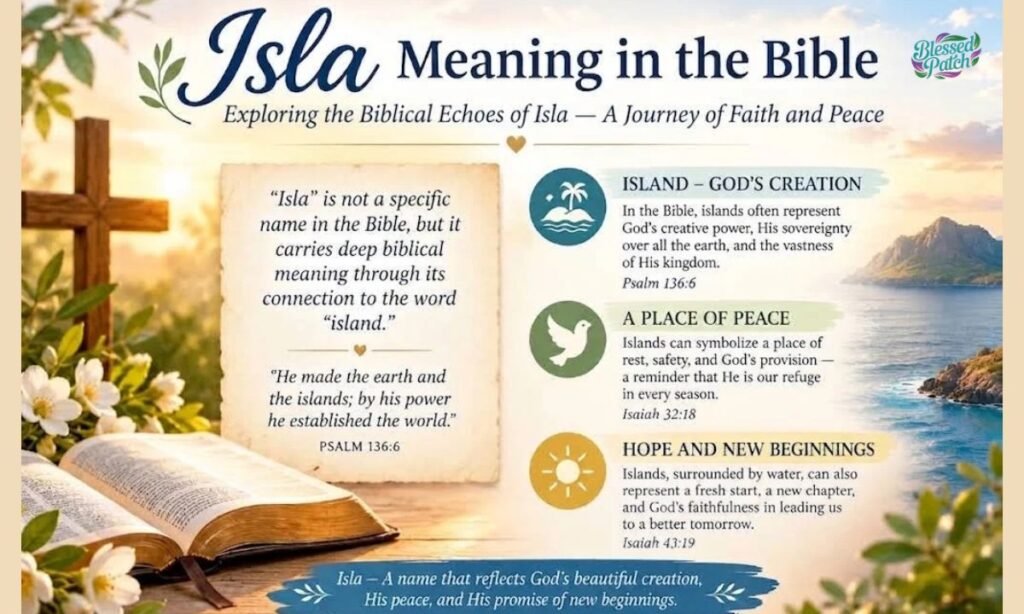
When people search for Isla Name Meaning in the Bible, they are often looking for a spiritual message behind the name.
There is no official biblical definition of Isla because the name does not appear as a traditional personal name in Scripture. Its spiritual meaning is therefore interpretive rather than a direct translation from Hebrew, Greek, or biblical Aramaic.
The strongest symbolic connection comes from the idea of an island. An island is surrounded by water but remains a distinct place. This can inspire thoughts about peace, protection, identity, and being set apart.
Biblical writings sometimes use islands and coastlands when speaking about distant peoples and nations. Isaiah 42:10, for example, includes the coastlands in a call to praise God.
For this reason, someone may choose Isla and connect it with a spiritual theme such as faith that remains steady, peace in difficult surroundings, or a life set apart for a meaningful purpose.
These are faith-based reflections, not an official biblical translation of the name.
Water and Islands as Biblical Symbols
Water is one of the most important images in the Bible. It can appear in stories of creation, cleansing, danger, deliverance, and renewal.
Islands and coastlands also appear in Scripture. The biblical use is broader than the modern baby-name meaning. In several passages, islands or coastlands represent distant regions and peoples.
This gives the name Isla an interesting symbolic connection with the natural world.
Water can remind Christians of renewal and God’s sustaining presence. An island can suggest stability in the middle of changing surroundings. Together, these images can inspire a meaningful reflection on faith.
Refuge, Peace, and Being Set Apart
An island can also be imagined as a quiet place away from the noise of the world. This makes peace and refuge natural spiritual themes for people who like the name Isla.
The Bible frequently uses shelter and refuge imagery. Isaiah 32:2 describes shelter from wind and storms, streams of water in a dry place, and the shade of a great rock.
This does not mean that Isla literally means “refuge” in the Bible. Instead, the imagery can be used as a spiritual reflection connected with the peaceful picture that an island may create.
Isla Name Meaning in Hebrew: Fact vs. Popular Symbolism
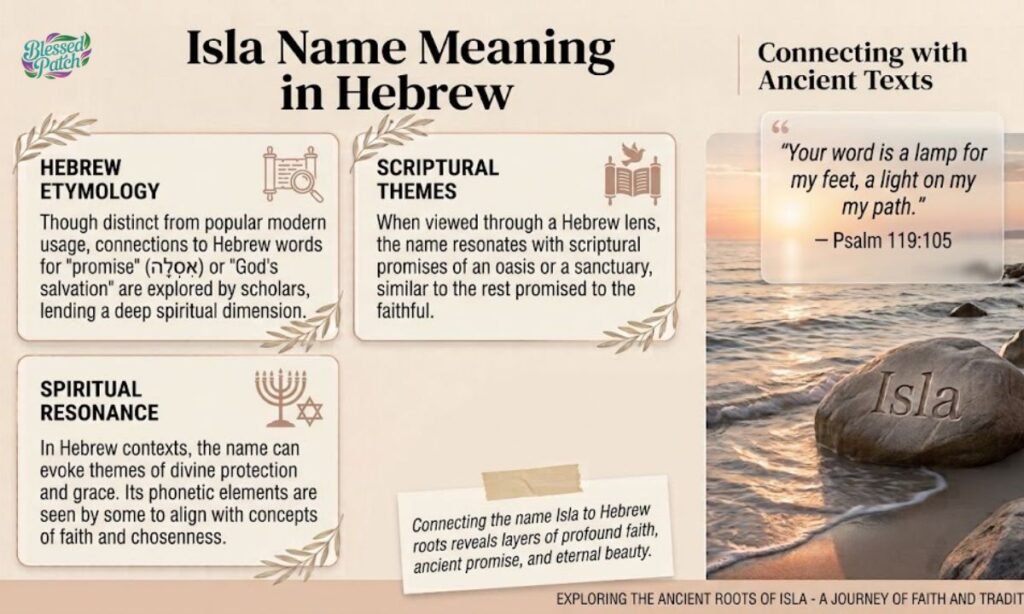
Isla is not a traditional Hebrew biblical name.
This is an important point because some baby-name websites may attach Hebrew meanings to names without providing a reliable historical connection. Isla should not automatically be described as a Hebrew name simply because someone has given it a Hebrew-inspired spiritual interpretation.
There is no need to invent a Hebrew meaning for Isla to make the name meaningful.
Its Scottish and Spanish associations already provide interesting cultural background. Its spiritual significance can then be discussed through biblical themes such as water, refuge, creation, peace, and distant lands.
So, when someone asks for the Isla name meaning in Hebrew, the safest answer is that Isla does not have an established Hebrew etymology as a biblical personal name. Any additional Hebrew symbolism should be clearly identified as interpretation rather than historical fact.
Bible Verses That Reflect the Meaning of Isla
Although Isla itself is not a biblical name, several Bible passages can reflect the themes people associate with it. These Bible verses offer meaningful connections to peace, refuge, faith, and spiritual strength.
Isaiah 32:2 is especially suitable because it combines shelter, refuge, water, and shade. The verse describes protection from storms and streams of water in a dry place.
Isaiah 42:10 is another interesting connection because it mentions the coastlands in a call to praise God. This fits naturally with the island imagery associated with Isla.
Isaiah 40:15 also refers to islands in a broader picture of God’s greatness and the smallness of the nations before Him.
These verses should not be presented as verses about the name Isla. Instead, they are Scripture passages whose themes can complement the imagery associated with the name.
For a Christian family, these verses can provide inspiration for a child named Isla without claiming that the name itself comes from Scripture.
What Does Isla Represent in Christian Faith?
In Christian faith, Isla can be given a personal symbolic meaning rather than a fixed biblical definition.
The name may remind a family of peace, faith, natural beauty, stability, and God’s presence. The image of an island can also suggest standing firm while surrounded by changing circumstances.
Another meaningful idea is being set apart. Christians may understand being set apart as living with purpose and faith rather than simply following every influence around them.
The name can therefore become a personal reminder of values that parents hope their child will carry.
It is important, however, to keep this interpretation separate from the historical origin of the name. Isla does not literally translate to a Christian virtue. Its Christian meaning comes from the themes and values a family chooses to associate with it.
Isla Name Spanish Meaning
The Spanish word isla means “island.”
This is perhaps the simplest meaning associated with Isla. In Spanish, the word refers directly to a piece of land surrounded by water.
The island image can create several positive associations. It can suggest beauty, nature, peaceful surroundings, and a place with its own identity.
This meaning also gives Isla a modern, international quality. The spelling is short, easy to recognize, and visually simple.
However, the Spanish vocabulary meaning should not be confused with the complete historical origin of the given name. The Scottish connection to Islay is an important part of the name’s history as well.
Isla Meaning in Different Cultures
Names can develop different associations when they move between languages and cultures. Isla is a good example because its modern use is connected with both Scottish naming traditions and the Spanish word for island.
In English-speaking countries, Isla is generally recognized as a feminine first name. In Spanish, isla is an ordinary noun meaning “island.”
These connections give the name a natural international appeal. A family may choose it because of its Scottish background, its Spanish meaning, its sound, or simply its modern style.
Romance-Language Connections
The idea of an island appears in several Romance languages.
In French, the word is île. In Italian, it is isola, while Portuguese uses ilha.
These words are related to the general concept of an island, but they should not be treated as alternate spellings of the personal name Isla.
The Spanish form is especially relevant because isla is exactly the same spelling as the modern given name.
Celtic and Gaelic Connections
Isla is strongly associated with Scotland through Islay and Scottish geographical names.
The wider Celtic and Gaelic world has many different words for geographical features, including islands. However, those words should not automatically be presented as direct translations or origins of the personal name Isla.
The strongest Scottish naming connection remains the association with Islay and the Scottish rivers named Isla.
Cultural and Religious Interpretations of Isla
Different families may understand Isla in different ways.
From a cultural perspective, the name can suggest Scotland, islands, water, and natural beauty. From a Spanish-language perspective, it has the straightforward meaning “island.”
From a Christian perspective, parents may connect the name with peace, refuge, creation, faith, and spiritual identity.
These interpretations can exist together without claiming that they all come from one ancient source.
A meaningful name does not always need to have a direct biblical definition. Sometimes its importance comes from the values parents connect with it.
For a Christian family, Isla could symbolize a peaceful life grounded in faith. For another family, the island meaning may simply represent nature and beauty.
Nicknames and Variations of Isla
Isla is already a short name, so it does not require a nickname. Still, families may create affectionate forms based on personal preference.
Possible informal nicknames include Issy, Isla-Belle, Is, and Lala. These are modern pet forms rather than official historical variations.
The name has also been connected with forms such as Islay, Ila, Ile, and Eylah in discussions of related naming forms. However, these should not all be treated as exact equivalents because their histories and spellings differ.
Popular Variations and Similar Names
Parents who like Isla may also consider names with a similar sound or style, such as:
- Ayla
- Lyla
- Lila
- Ella
- Elia
- Islay
- Iona
- Isla-Rose
Iona can be especially interesting to families who like Scottish-inspired names, while Ayla and Lyla offer a similar soft sound.
Similar names are not necessarily related in origin. They simply share sound, style, or cultural appeal.
Isla Name Popularity and Global Usage Trends
Isla has become a familiar name in several English-speaking naming communities.
In the United States, the Social Security Administration reported that Isla ranked 28th among girls’ names in 2025, up from 35th in 2024. This shows that the name was already highly popular and moved seven places upward in one year.
The SSA’s longer-term data also place Isla among the notable girls’ names of the 2020s. From 2020 through 2025, Isla ranked 35th by total number of recorded births in the decade-to-date table, with 32,186 births in that period.
These statistics are specific to the United States and should not be treated as a worldwide ranking. Naming patterns can vary greatly from one country to another.
The name’s popularity is likely helped by several qualities: its short spelling, easy visual appearance, Scottish association, Spanish word meaning, and soft pronunciation.
Famous People Named Isla and Their Influence
Several notable women have the first name Isla.
One of the best-known examples is Isla Fisher, an Australian actress and author. Her public career has helped make the name familiar to international audiences.
Other people named Isla include British actress Isla Blair, Scottish actress and singer Isla St Clair, and Scottish novelist and screenwriter Isla Dewar. The name therefore appears across acting, music, journalism, and literature.
The presence of public figures with the name does not determine its meaning or origin. Instead, it shows how Isla has been used across different generations and professional fields.
Beautiful Middle Names That Pair Well With Isla
Because Isla is short and soft-sounding, it pairs well with both traditional and modern middle names. Here are some beautiful combinations with their meanings and significance:
| Style | Middle Name | Full Name | Meaning / Significance |
| Faith-inspired | Grace | Isla Grace | Grace, kindness, and God’s favor |
| Faith-inspired | Faith | Isla Faith | Trust and belief in God |
| Faith-inspired | Hope | Isla Hope | Hope, optimism, and spiritual confidence |
| Faith-inspired | Joy | Isla Joy | Happiness, gratitude, and spiritual joy |
| Nature-inspired | Rose | Isla Rose | Beauty, love, and the rose flower |
| Simple | Mae | Isla Mae | A sweet, classic, and gentle name |
| Classic | Elizabeth | Isla Elizabeth | “God is my oath” |
| Classic | Catherine | Isla Catherine | Often associated with purity |
| Classic | Jane | Isla Jane | “God is gracious” |
| Traditional | Marie | Isla Marie | A traditional form of Mary |
| Modern | Sophia | Isla Sophia | Wisdom |
| Elegant | Noelle | Isla Noelle | Christmas and the birth of Christ |
| Elegant | Victoria | Isla Victoria | Victory and triumph |
| Traditional | Ruth | Isla Ruth | Friendship, loyalty, and compassion |
| Nature-inspired | Willow | Isla Willow | Grace, flexibility, and the willow tree |
For a faith-centered choice, Isla Grace, Isla Faith, Isla Hope, and Isla Joy have meaningful Christian associations. For a classic style, Isla Elizabeth, Isla Catherine, and Isla Jane create a timeless combination.
When choosing a middle name, say the full name aloud several times. A good combination should sound natural with the child’s first and last name.
The Enduring Beauty of the Name Isla
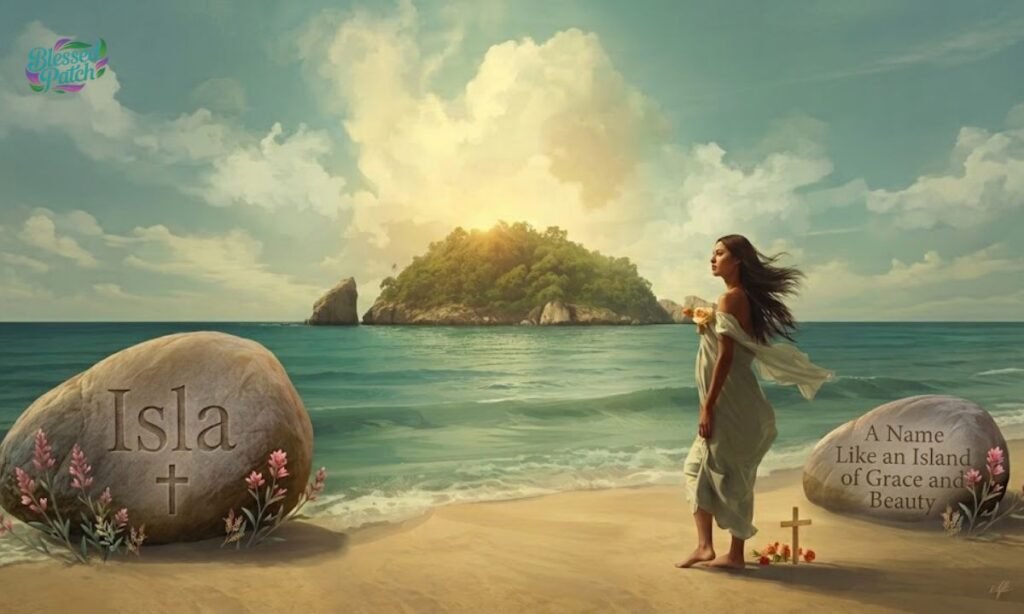
Isla brings together several appealing ideas without needing an invented biblical origin. Its history is associated with Scotland, particularly Islay and Scottish geographical names, while the Spanish word isla means “island.”
From a biblical perspective, Isla is not a traditional personal name found in Scripture. Its spiritual meaning is therefore best understood through symbolism rather than direct biblical etymology.
The themes connected with the name can still be meaningful. Islands and coastlands appear in biblical passages, while Scripture also uses powerful images of water, shelter, refuge, and peace.
For families of faith, Isla can serve as a beautiful reminder of peace, strength, purpose, and trust in God. For others, its island meaning may simply evoke nature, freedom, and beauty.
Ultimately, the Isla name meaning is richer when its history and symbolism are kept separate. Its Scottish roots, Spanish meaning, modern popularity, and faith-inspired associations each add a different layer to this graceful name.
Frequently Asked Questions
What is the Isla Name Meaning in the Bible?
Isla is not a traditional biblical name, but its meaning can be connected with biblical themes such as water, refuge, and peace.
What does Isla mean spiritually?
Spiritually, Isla can symbolize peace, protection, faith, and being set apart.
Is Isla a biblical name?
No, Isla is not directly mentioned as a personal name in the Bible.
What is the Isla name meaning in Islam?
There is no established Islamic or Arabic meaning for Isla; its commonly recognized meaning is “island” in Spanish.
Is Isla a good name for a baby girl?
Yes, Isla is a short, graceful name with a soft sound and meaningful cultural and nature-related associations.
Conclusion
The Isla name meaning connects Scottish history, Spanish language, and the beauty of nature. Although Isla is not a traditional biblical name, its associations with water, islands, peace, and refuge can have meaningful spiritual value.
When exploring Isla meaning in the Bible, it is helpful to separate history from personal faith. Its Scottish origins, Spanish meaning, and spiritual symbolism give Isla a graceful and timeless appeal.

Rebecca is a dedicated writer with 4 years of experience creating blogs about blessings, prayers, and Bible verses. She now contributes to BlessedPatch.com, sharing uplifting messages, faith-based inspiration, and daily spiritual content to encourage readers and strengthen their connection with God.